

Here’s what Google doesn’t want you to know: clicks don’t just matter for rankings—they’re one of the most powerful signals in their entire algorithm. And we finally have proof.
For years, Google publicly denied that user clicks directly influenced search rankings. Matt Cutts said it would be “a mistake” to use clicks directly. Gary Illyes deflected questions about user behavior signals. The official line was always the same: we look at hundreds of factors, but click data? Too noisy. Too easy to manipulate.
Then their own executives testified under oath.
During the 2023 DOJ antitrust trial, Pandu Nayak—Google’s VP of Search—confirmed that NavBoost, a click-based ranking system dating back to 2005, is “one of Google’s strongest ranking signals.” A few months later, 14,000+ internal API documents leaked onto GitHub, revealing the exact metrics Google tracks: goodClicks, badClicks, lastLongestClicks, and more.
The cat isn’t just out of the bag. It’s running down the street.
This guide breaks down everything we now know about NavBoost from three definitive sources: a 2004 Google patent that laid the groundwork, sworn testimony from Google’s own engineers, and leaked internal documentation that shows exactly how the system works. If you’re serious about SEO, this changes how you think about rankings.
What Is NavBoost? The System Google Hid for 20 Years
NavBoost is a user interaction-based ranking system that tracks how people engage with search results and uses that data to adjust future rankings. It’s been running quietly in the background since approximately 2005, continuously learning from billions of clicks.
The basic concept is straightforward: when you search for something and click a result, Google watches what happens next. Did you stay on that page? Did you come back to the search results immediately? Did you click something else? All of that gets recorded, aggregated across millions of users, and fed into a system that decides which pages deserve to rank higher—and which ones should drop.
Pandu Nayak described it during his testimony: “Navboost is looking at a lot of documents and figuring out things about it. So it’s the thing that culls from a lot of documents to fewer documents.”
Translation: NavBoost acts as a filter. After Google’s initial ranking algorithm generates a list of potentially relevant pages, NavBoost steps in and re-ranks them based on how real users have interacted with those results over time.
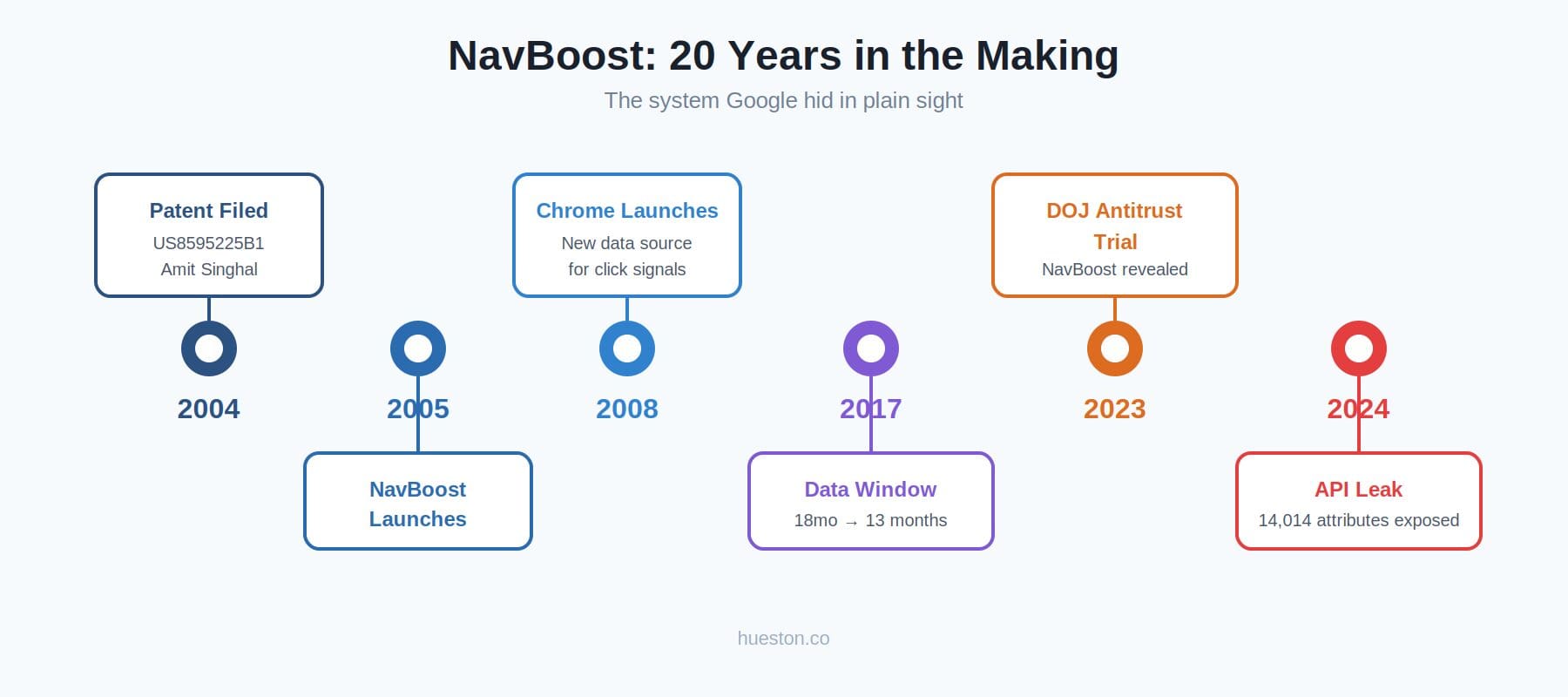
The system uses a rolling 13-month window of click data. Before 2017, that window was 18 months. Every click you make—and every click millions of other users make—gets stored and analyzed for over a year.
NavBoost also segments this data into what Google calls “slices.” There’s a slice for different countries, different states or provinces, and different device types. Mobile searches have their own NavBoost model. So does desktop. The system is sophisticated enough to understand that user behavior differs dramatically depending on context.
There’s also a related system called Glue. While NavBoost focuses specifically on the traditional “ten blue links” in search results, Glue handles everything else on the page—the knowledge panels, image carousels, video results, People Also Ask boxes, and other SERP features. Glue tracks clicks, hovers, scrolls, and swipes on these elements and creates a common metric to compare them with standard web results.
Nayak explained the distinction clearly: “Glue is just another name for NavBoost that includes all of the other features on the page.”
| NavBoost Quick Facts | Details |
|---|---|
| Year Created | ~2005 |
| Data Window | 13 months (was 18 months pre-2017) |
| Primary Focus | Web search results (blue links) |
| Related System | Glue (handles SERP features) |
| Signal Type | User interaction/click data |
| Status | Active, continuously updated |
For nearly two decades, Google operated this system while publicly downplaying the role of user behavior in rankings. That changed when they had to explain themselves under oath.
The 2004 Patent That Started It All
Before NavBoost had a name, it had a blueprint.
In September 2004, Google filed a patent titled “Systems and methods for correlating document topicality and popularity.” The patent number is US8595225B1, and the listed inventors are Amit Singhal and Urs Hoelzle—two of the most influential engineers in Google’s history.
Singhal, in particular, is significant. He’s widely credited as one of the architects behind Google’s ranking systems during their most formative years. When we learned from trial testimony that NavBoost dated back to around 2005, SEO researchers started digging through Singhal’s patent history. This one fit perfectly.
The patent describes a system for tracking how users interact with documents (web pages) and using that data to assign “popularity scores.” These scores then get correlated with topical relevance to improve search results.
Here’s the key passage: “A document that has been visited by users more often than another document may have a higher popularity score.”
The patent doesn’t explicitly use the word “clicks.” Instead, it talks about “user navigational patterns” and “document selection.” But the meaning is clear—you can’t have navigational patterns without users clicking on things. The system described in this patent is functionally identical to what Nayak described in his testimony.
The patent outlines three core mechanisms that map directly to NavBoost’s known functionality.
The first mechanism involves tracking user interactions. Documents visited by users get associated with identifiers, and the system tracks how often each document gets selected from search results. This creates a behavioral feedback loop where user choices directly inform future rankings.
The second mechanism is popularity scoring. Based on interaction frequency, each document receives a score. Documents that users engage with more frequently get higher scores. These aren’t absolute numbers—they’re relative rankings that compare documents against each other for specific queries.
The third mechanism is topical correlation. The system maps documents to specific topics and calculates “per-topic popularity information.” This is crucial because it means NavBoost doesn’t just track overall popularity—it tracks popularity within specific contexts. A page might be popular for one type of query but irrelevant for another, and the system accounts for that.
What makes this patent particularly interesting is that it was filed during the height of PageRank’s dominance. In 2004, everyone in SEO was obsessed with links. Google’s public messaging emphasized authority and trustworthiness as determined by who linked to you. But internally, they were already building a parallel system based on what users actually did.
Matt Cutts once explained the difference between popularity and authority in a video: “Popularity in some sense is a measure of where people go whereas PageRank is much more a measure of reputation.”
The 2004 patent is the foundation for that popularity measurement. NavBoost is its operational implementation.
The DOJ Antitrust Trial: NavBoost Goes Public
October 2023 marked a turning point. The United States Department of Justice put Google on trial for allegedly maintaining an illegal monopoly in search. To defend themselves, Google had to explain how their search engine actually works—under oath, with documentation.
The SEO community had never seen anything like it.
Pandu Nayak took the stand as Google’s VP of Search, a role he’s held since 2004. His testimony runs to hundreds of pages and contains more direct information about Google’s ranking systems than anything the company has ever released publicly.
NavBoost came up repeatedly. The name appears 54 times in the transcript, making it one of the most discussed ranking systems in the entire trial.
When asked directly about NavBoost’s origins, Nayak confirmed the timeline.
“NavBoost was created around 2005. I believe it was 2005, in that range.”
That’s two decades of click-based ranking—running continuously while Google told the SEO industry that clicks were just “noisy data.”
Nayak didn’t just confirm existence. He confirmed importance. When asked about NavBoost’s role in the ranking system, his response was unambiguous.
“We have two fundamental signals, quality, things like PageRank and the quality of the page, and the other one is the popularity. So NavBoost would be the popularity one.”
Quality and popularity. PageRank and NavBoost. These aren’t minor signals—they’re described as the two fundamental pillars of Google’s ranking system.
Eric Lehman, a former Distinguished Engineer at Google who worked on search quality and ranking for 17 years, provided even more revealing statements. When questioned about whether Google uses click data for rankings, Lehman’s response was surprisingly candid.
“Pretty much everyone knows we’re using clicks in rankings. Why are you trying to obscure this issue if everyone knows?”
This wasn’t a slip-up. Lehman was acknowledging what the SEO community had suspected for years—Google deliberately avoided confirming click-based ranking because it might make the signals easier to manipulate.
The most striking evidence came from internal communications. An email from Alexander Grushetsky, a Google VP, was presented during the trial. His assessment of NavBoost’s power was direct.
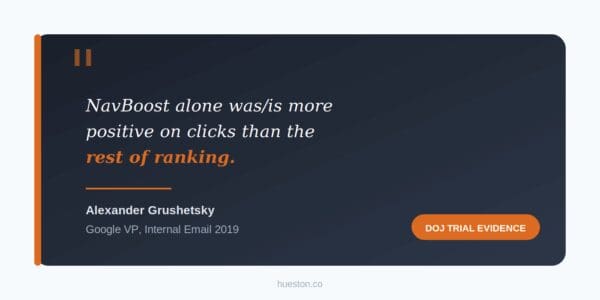
Read that again. A Google VP stated in writing that NavBoost—a single click-based system—has more positive impact on rankings than everything else combined. That includes PageRank, content quality signals, technical SEO factors, and every other ranking system Google operates.
The trial also revealed internal documentation about NavBoost’s structure. Paul Haahr, a Google engineer, had NavBoost listed prominently on his internal resume with the note: “This is already one of Google’s strongest ranking signals.”
The evidence painted a consistent picture: NavBoost isn’t a supplementary signal that provides minor adjustments. It’s a core component that fundamentally shapes what ranks where.
The 2024 API Leak: Technical Proof
If the DOJ trial pulled back the curtain, the API leak tore the whole thing down.
In May 2024, SEO researcher Erfan Azimi received a massive document dump from an anonymous source. Over 2,500 pages of internal Google API documentation had been accidentally exposed through a GitHub bot and subsequently archived. The documents dated from March 27, 2024, making them remarkably current.
Rand Fishkin of SparkToro and Mike King of iPullRank published detailed analyses of the leaked documents. What they found confirmed the trial testimony—and added substantial technical detail.
The leak contained over 2,500 pages of API documentation describing 14,014 attributes from what Google calls the “Content API Warehouse.” Among these attributes were specific references to NavBoost and its click-tracking mechanisms.
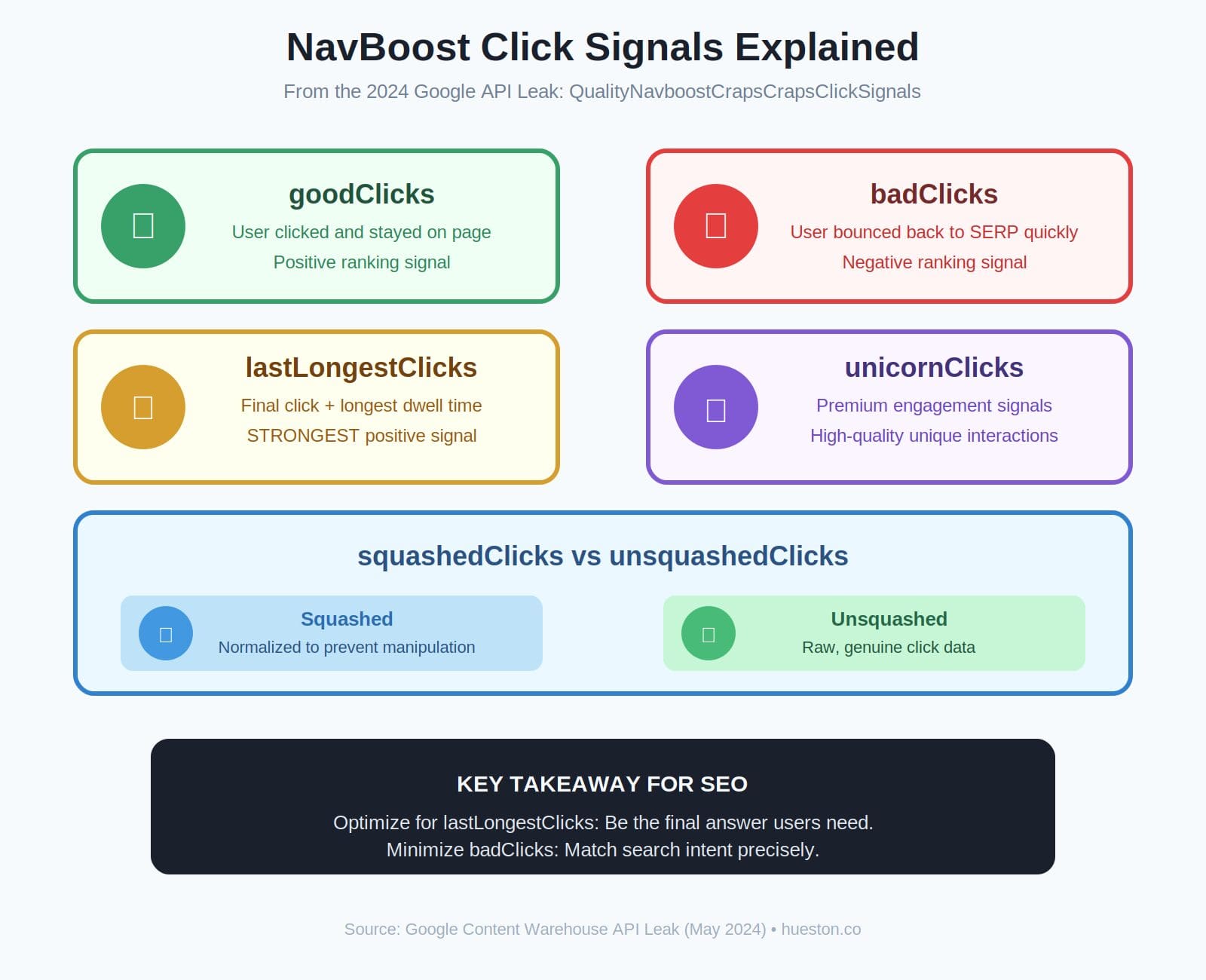
The documentation revealed a module called “QualityNavboostCrapsCrapsClickSignals” that tracks several distinct click types.
QualityNavboostCrapsCrapsClickSignals {
  badClicks
  goodClicks
  lastLongestClicks
  unsquashedClicks
  unsquashedLastLongestClicks
  unicornClicks
}
Each of these represents a specific type of user interaction signal.
goodClicks are exactly what they sound like—positive engagement signals where users clicked a result and appeared satisfied with what they found.
badClicks represent negative signals. These occur when users click a result and quickly return to search results, indicating the page didn’t satisfy their query.
lastLongestClicks may be the most important signal. This tracks the final click in a user’s search session that led to the longest engagement. If you search for something, click multiple results, and finally settle on one page where you spend significant time, that’s a lastLongestClick. It’s a strong signal that the page definitively answered the user’s query.
unicornClicks appear to represent particularly high-quality engagement signals, though the exact criteria aren’t fully documented.
unsquashedClicks and unsquashedLastLongestClicks reveal something important about how Google processes this data. “Squashing” refers to a normalization technique that prevents any single signal from having outsized influence. The existence of both squashed and unsquashed versions suggests Google stores raw click data separately from its processed version.
The API documentation also confirmed several technical aspects that the SEO community had theorized about.
NavBoost operates at both the document level and the host level. This means poor user engagement signals on one page can affect rankings across an entire domain. It’s not just individual pages being evaluated—Google tracks aggregate user satisfaction metrics by domain.
The system includes geographic segmentation. Different NavBoost “slices” exist for different countries and regions, confirming that user behavior patterns are localized rather than globally aggregated.
Chrome browser data contributes to NavBoost signals. The documentation references integration with Chrome usage data, confirming long-held suspicions that Google leverages its browser dominance for search quality signals.
The leak also revealed the existence of quality whitelists and overrides. Certain sites—particularly during sensitive events like COVID-19 or elections—can be manually protected from normal ranking adjustments. This confirms that while NavBoost is automated, Google maintains override capabilities for situations they deem important.
The NavBoost Ranking Pipeline: How It Actually Works
Piecing together information from all three sources—the patent, trial testimony, and API leak—we can now describe NavBoost’s role in Google’s ranking pipeline with reasonable confidence.
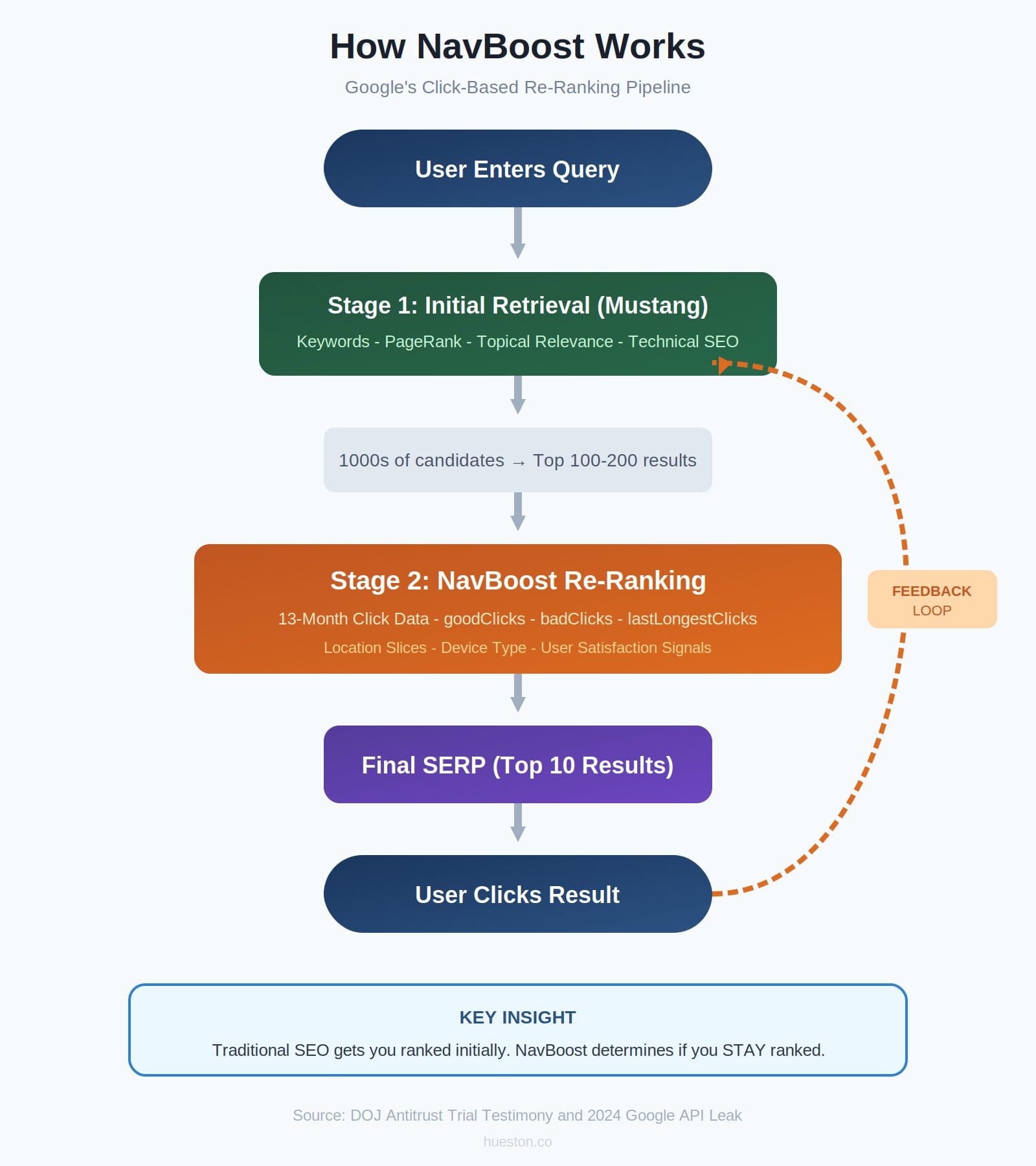
When a user enters a search query, Google’s systems first generate an initial set of potentially relevant documents. This retrieval phase uses various signals including keyword matching, topical relevance, and quality indicators like PageRank. The system generates thousands of potential matches.
These results then pass through multiple ranking stages. The initial ranking uses what Google internally calls “Mustang”—their core algorithmic ranking system. Mustang evaluates traditional ranking factors to narrow thousands of candidates down to a few hundred.

NavBoost enters the pipeline after initial ranking. Using 13 months of aggregated user interaction data, NavBoost re-ranks these candidates based on how users have historically engaged with each result for similar queries. Documents with strong positive signals move up. Documents with negative signals drop.
The final ranking incorporates both algorithmic scores and NavBoost adjustments. What you see on page one of Google reflects a combination of traditional ranking factors and real user behavior data collected over the previous year.
This explains something that has puzzled SEOs for years: why pages sometimes rank well despite apparent weaknesses in traditional ranking factors, and why other pages rank poorly despite seemingly perfect optimization. NavBoost provides the missing variable—actual user satisfaction data that can override algorithmic predictions.
What NavBoost Tracks and How to Optimize
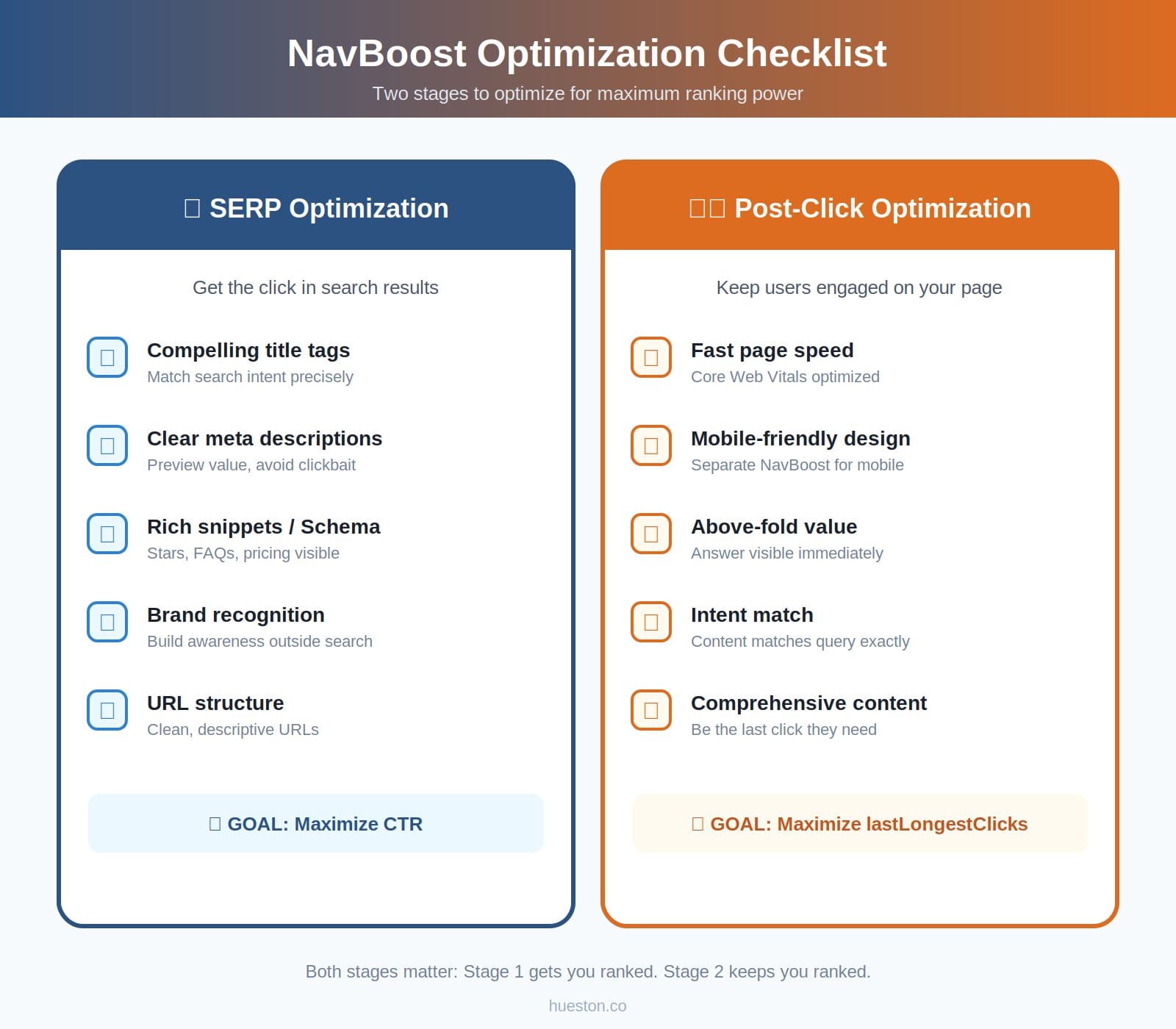
Understanding what NavBoost measures is the first step toward optimizing for it. Based on the evidence, here are the key signals and practical optimization approaches.
Click-through rate from search results matters. NavBoost tracks how often users click your result compared to others. Optimizing title tags and meta descriptions for both relevance and appeal directly impacts this signal. Your SERP listing is an advertisement—treat it like one.
Post-click engagement is measured. What users do after clicking determines whether you get a goodClick or badClick. Fast page load speeds, mobile-friendly design, and immediately visible relevant content all reduce bounce probability. The first few seconds after a click are critical.
Session behavior indicates satisfaction. lastLongestClicks represents users who searched, possibly clicked multiple results, and finally settled on yours. To earn this signal, your page needs to definitively answer the user’s query. Comprehensive content that addresses related questions keeps users from returning to search.
Return visits may be tracked. While not explicitly confirmed, the API documentation suggests Google tracks whether users return to results they’ve previously clicked. Becoming a trusted resource that users bookmark or navigate to directly creates compounding positive signals.
Squashing prevents manipulation but rewards consistent performance. You can’t game NavBoost with traffic bots or click farms—the squashing mechanisms detect and filter artificial patterns. But consistent, genuine user satisfaction from real searches accumulates into stronger signals over time.
Here’s a practical optimization framework based on these signals.
| NavBoost Signal | What Google Measures | Optimization Approach |
|---|---|---|
| Click-through rate | Selection frequency from SERPs | Compelling titles, accurate meta descriptions, rich snippets |
| goodClicks | User satisfaction after click | Fast loading, immediate value above fold, clear navigation |
| badClicks | Quick returns to search results | Match search intent precisely, avoid misleading titles |
| lastLongestClicks | Final click with long engagement | Comprehensive content, answer related questions, high readability |
| Device-specific signals | Behavior by device type | Optimize separately for mobile and desktop experiences |
| Geographic signals | Behavior by location | Localize content where appropriate, consider regional intent differences |
Common Misconceptions About NavBoost
The revelations about NavBoost have generated significant discussion—and some misunderstandings. Let’s address the most common ones.
Myth: NavBoost is new or recently implemented.
NavBoost has been operational since approximately 2005. The patent describing its mechanisms was filed in 2004. What’s new isn’t the system—it’s our confirmed knowledge that it exists and how important it is. Google operated NavBoost for nearly two decades while publicly downplaying click-based ranking.
Myth: You can game NavBoost with click bots or paid traffic.
The squashing mechanisms specifically exist to prevent this. Google normalizes click data to detect and filter artificial patterns. The API leak confirmed that both “squashed” and “unsquashed” versions of click data are stored, indicating Google maintains raw data specifically to identify manipulation attempts. Paid traffic or click services are more likely to trigger spam detection than improve rankings.
Myth: NavBoost only affects small or new sites.
NavBoost applies to all pages in web results. Large, established sites accumulate NavBoost signals just like everyone else. In fact, the host-level evaluation means that large sites can suffer domain-wide impacts from poor user engagement signals.
Myth: Short clicks are always bad signals.
Context matters. Some queries have naturally short click durations—users looking up a quick fact, checking a definition, or verifying a piece of information might find what they need in seconds. NavBoost accounts for this through query-level modeling. What matters is whether users return to search results looking for more, not absolute time on page.
Myth: NavBoost replaced PageRank and traditional SEO factors.
They work together. The trial testimony explicitly described two fundamental ranking signals: Quality (PageRank, authority) and Popularity (NavBoost, user engagement). You need quality signals to rank initially. You need popularity signals to maintain and improve those rankings. Abandoning traditional SEO in favor of pure user engagement optimization would be a mistake.
Myth: Recovery from bad NavBoost signals is quick.
The 13-month data window means bad signals persist for over a year. Even if you fix everything wrong with your page today, historical data continues to influence rankings until enough time passes. Recovery is possible, but it’s gradual. The best strategy is avoiding negative signals in the first place.
The Bigger Picture: Why NavBoost Changes SEO Strategy
NavBoost represents a fundamental shift in how search rankings work—and how SEO should be approached.
For most of search history, the optimization target was Google’s algorithms. Figure out what signals the algorithm looks for, provide those signals, rank higher. Keywords, backlinks, technical factors, content quality—all of these targeted the algorithm directly.
NavBoost adds a layer that targets users instead. The algorithm still matters for initial rankings, but users determine whether you keep those rankings. Their behavior becomes the feedback mechanism that adjusts positions over time.
This changes the strategic calculus.
Tactics that trick algorithms but disappoint users become counterproductive. You might be able to rank initially through clever optimization, but if users consistently bounce, NavBoost will push you down. Short-term wins create long-term losses.
Conversely, genuine user value gets rewarded even when traditional optimization isn’t perfect. A page that delights users—that becomes their last click, that they return to, that they share—will accumulate positive signals that boost rankings regardless of whether every technical SEO box is checked.
Brand building becomes a ranking factor. Users click results they recognize and trust. Building brand awareness outside of search creates recognition that improves SERP click-through rates, which generates positive NavBoost signals, which improves rankings further. The compound effect is significant.
User experience optimization becomes SEO. Page speed, mobile usability, content quality, navigation design—these UX concerns directly impact the behavioral signals NavBoost tracks. The line between “SEO” and “UX” blurs when user behavior determines rankings.
The feedback loop creates momentum effects. Pages that perform well accumulate positive signals that help them continue performing well. Pages that struggle accumulate negative signals that make recovery harder. First-mover advantage and established authority carry more weight when you’re building on months of behavioral data.
The 13-month window also creates strategic planning implications. Ranking improvements based on NavBoost don’t happen overnight. A comprehensive optimization effort might take months to show full results as positive signals gradually outweigh historical negatives. Patience becomes necessary.
And negative events have lingering effects. A site outage, a broken page, a content quality drop—anything that generates bad user engagement during the period affects rankings for over a year afterward. Risk management and monitoring become more important when the consequences persist.
What This Means for Your SEO Strategy
If you’ve read this far, the implications are probably already forming in your mind. Let me make them explicit.
First, clicks absolutely matter. Stop pretending they don’t. Every user interaction with your search results feeds into a system that directly influences future rankings. Optimizing for click-through rate isn’t vanity metrics—it’s core SEO.
Second, user satisfaction is the goal, not the byproduct. Everything that makes users stay on your page, engage with your content, and not return to search results contributes to positive NavBoost signals. Design your pages around satisfaction, not just search visibility.
Third, speed and mobile performance are ranking factors in practice, even if not in name. Slow pages lose users before they can generate any positive signals. Mobile users bouncing because of poor responsive design accumulate badClicks. Technical performance has never mattered more. Focus on Core Web Vitals as a starting point.
Fourth, intent matching is non-negotiable. The penalty for misleading users is measured directly through behavior. If your page ranks for queries it doesn’t actually answer well, NavBoost will correct that over time. Better to rank for fewer queries where you genuinely satisfy intent than many queries where you disappoint.
Fifth, brand building has SEO value. Recognition drives clicks, clicks drive signals, signals drive rankings. Investment in brand awareness outside of search pays dividends within search.
Sixth, recovery takes time. If your site has accumulated negative NavBoost signals, the path forward is gradual improvement over months, not quick fixes. Plan accordingly and set realistic expectations.
Seventh, the best SEO is genuine user value. This has always been true in theory, but NavBoost makes it true in practice. Google has built a system that measures—imperfectly, but at scale—whether pages actually satisfy users. Gaming that system means gaming real human behavior, which is much harder than gaming algorithmic signals. (recently there have been a few sites that have shown results in manipulating these results – NavBoosted)
The sites dominating search today understand that NavBoost rewards one thing above all else: being the result users actually want. Everything else is just a path to get there.
NavBoost: The Complete Summary
| Source | Key Revelation | SEO Implication |
|---|---|---|
| 2004 Patent (US8595225B1) | User navigational patterns determine popularity scores | Clicks have been ranking signals for 20+ years |
| DOJ Trial – Nayak Testimony | NavBoost is “one of Google’s strongest signals” | User behavior is not secondary—it’s fundamental |
| DOJ Trial – Lehman Testimony | Google “avoided confirming” click usage publicly | The system was intentionally obscured |
| DOJ Trial – Internal Email | NavBoost alone was “more positive than the rest of ranking” | This single system can outweigh other factors |
| 2024 API Leak | goodClicks, badClicks, lastLongestClicks tracked | Specific metrics can be optimized for |
| 2024 API Leak | 13-month rolling window confirmed | Performance compounds or degrades over time |
| 2024 API Leak | Squashing prevents manipulation | Bot traffic and click spam are filtered |
Ready to Optimize for How Google Actually Works?
Understanding NavBoost is step one. Implementing strategies that generate positive user signals across your entire site is where results happen.
Hueston specializes in SEO that accounts for how Google really ranks pages—not how they say they rank pages. We build sites that users love, which means Google loves them too.
Get a free audit to see how your site performs on the metrics that actually matter.